June 03, 2014

Favorite Color Tools for Google Chrome

Is there anything better than a little tool that makes life easier? No! There isn't. So here is a little list of some of my very favorite tools for creating, saving, choosing, and playing with colors in Google Chrome. I could not do half of what I do without these little helpers. I use them almost daily and they deserve a full blown post. So here goes!

Palette for Chrome 

First up, one of my secret weapons (it's not really a secret) Palette for Chrome. This one is so easy and amazing, it's a must-have.
Using the Google Chrome extension Palette for Chrome color tool
Right click any image to bring up the Palette for Chrome options.
Palette for Chrome gives you the ability to right click on any image and instantly create a color palette. You can choose the number of colors you want, and it provides both the hex #'s and the RGB values.

Palette for Chrome sample palette
Instant color palette! 
I often use it right in Pinterest, copy the hex number, paste it into Photoshop and create color swatches for most of my work that way. I have zero issues with this extension. Love it!
Palette for Chrome color tool extension

Huey

Huey is an absolutely essential Chrome app for me. It's sort of like an easier, more convenient, personal version of ColourLovers. Huey is also 100% usable while offline. 
Saved colors in Huey app for Google Chrome
My currently saved colors in Huey.
Once inside, you can create your own colors and then save them for later. It's easy, very reliable, and has become a tool that I use constantly. 
Custom color created in Huey app for Google Chrome
A custom green color I created in Huey. Just click the star to add a color to your favorites.
Before Huey, I just wrote Hex codes on whatever paper was closest to me and then I'd inevitably lose it. Not anymore. Life is much better with Huey. One caveat: I wish it was easier to select the hex codes for copying and pasting. Currently you have to select the color from your saved ones, and then wrestle about in order to properly select the text to be copied. Maybe I'm doing it wrong. But it's not that big of a deal. It still works, and I would be sad without it!
I actually feel silly even mentioning Colorzilla. Is there anyone out there who doesn't already have it? It is the ultimate color tool. 
Using the color picker in Colorzilla for Google Chrome
Colorzilla color picker in-use
Colorzilla has a little eyedropper that lets you select any color on any page and automatically copies the hexcode to your clipboard. Awesome. Even better, it keeps a history of recently picked colors, which I often refer to. 
Webpage color analyzer tool in Colorzilla for Google Chrome
The colorzilla css color  analyzer in-use on the Martha Stewart website
My favorite part of Colorzilla is the webpage color analyzer. It will list all of the hex codes used in the css of any website. Yes!

0to255

This last one isn't actually an app or extension for Chrome, but it is a very important part of my color arsenal, so it just felt weird not including it in this list. It's a very simple website called 0to255, developed by Shaun Chapman. I have no idea how I found it, but I've been using it for a few years now, and it has become so useful!
Choosing colors on the 0to255 website
Useful color shades at 0to255.com
Let's say you're using a certain color, and you need the same color just a shade lighter or darker. Here comes your friend 0to255. Type in the hex code, and up comes every shade of your color from white to black. Click on a color, and it will automatically be copied to your clipboard. Thank you  Shaun Chapman and your 0to255 for making my life easier. :D


June 02, 2014

Anatomy of a Birth Chart

Many people think of Astrology as being a "sign." But this is so not true. When someone says "I am a Virgo," or "My sign is Taurus" or any other sign, what they are actually referring to is the fact that the sun was located in  one of the 12 zodiac signs when they were born. "I'm a Scorpio," for instance, means that the sun was located in the sign of Scorpio when I was born. But I am so much more than a Scorpio. I am complicated. Very complicated. In fact, ALL humans are complicated. All of life is complicated. And so are you. And you, too, are much more than your sun's sign.
Astrology painting
Did you know that the only reason horoscopes go by the sign of a person's sun is because it's the easiest to calculate? NOT because it's all there is or because it's the most important. It's because all you need to know is the day of your birth. But if you were to go deeper and also look at the exact time and location of your birth, you would be able to see where every planet in the entire solar system was located when you were born and so much more.

So forget your "sign" for now. Forget your "horoscope". Forget how well you think a Capricorn gets along with a Cancer, etc. None of that essentially means anything (really, it doesn't!) because humans are way too complex for such simple, general descriptions. And nobody is just their sun sign. True Astrology encompasses all of the solar system and approaches each part of the solar system as a piece of a larger whole. (Everything is connected.) And true Astrology is just as intricate, multifaceted, contradictory, and complicated as you are, as all humans are.

Astrological Glyphs

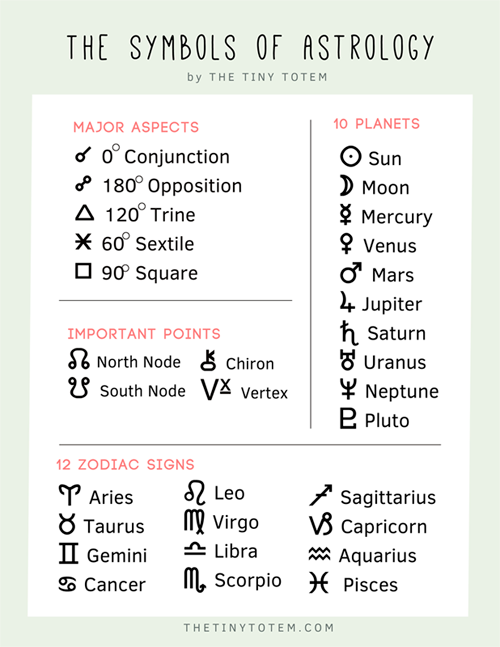
Just as you would not teach a child to read before they knew the alphabet, it is very difficult to understand Astrology without first knowing its alphabet, or rather, its glyphs / symbols. The more you study Astrology, the quicker you can grasp the symbols, and eventually you will know them backwards and forwards. Ideally, however, you would try to memorize them as fast as possible, as doing so is truly the first step on the Astrology journey. Astrology, after all, is a language. I will go in much more detail about how it's a language and the significance of each glyph later but for now here is a chart of the most important glyphs a beginner should know. Click the image for a printable version. :)
Astrology symbols printable

It's Complicated

Despite it being essentially symbolic, Astrology is still very much mathematical (specifically, trigonometry / geometry), and therefore explaining how, exactly, an Astrology chart is calculated can get pretty complicated and confusing. I want all of my Astrology posts to be explained as simply as possible, using regular language so you can really get it. So I will try to refrain from using too much jargon and Astro-talk, but if you want to know all the intricate specifics about how a birth chart is calculated, I can refer you to here and here. Have fun with that. :)

Before I continue, remember this: Astrology is not Astronomy. The two are very different. Astronomy is a science that studies the universe and the solar system. Astrology is a language that interprets the symbols represented by the placements of the planets and constellations in the sky at any given time.

We all know that the sun is the center of the solar system. However, because Astrology is the study of the planets' relationship to our human locations here on earth, Astrology charts depict the earth at the center with the rest of the solar system and the constellations - known as the ecliptic plane - placed around it. This is called a geocentric solar system which puts earth at the center rather than the sun. This way we can get a better look at the relationships between the planets, the sun, and the moon to that of our perspective here on earth. If we lived on the sun, we would put the sun in the center.

The Birth Chart

A Birth Chart or Natal Chart is a chart that Astrologer's use to look at the locations (specifically, the degrees) of and the relationships between the planets and zodiac signs at the time of one's first breath. The locations and relationships are then interpreted as symbols that represent the person's natural tendencies, energies, potential challenges, talents, and more. Technically, it is just a map of the planets' locations at the time and place of one's birth. All birth charts are comprised of the following "building blocks":
Planets
The Sun, Moon, Mercury, Venus, Mars, Jupiter, Saturn, Uranus, Neptune, and most definitely, yes, little Pluto too. Each planet represents a different type of energy, that is, a person's drives, urges, tendencies, and more. They are the "actions" of a birth chart. Think of them as verbs. These different drives, symbolized by the planets, can be heavily modified based on the house and sign that a planet is located in. If we are looking at a theatrical play on stage, the planets would be the actors. 
SIGNS
A birth chart is divided into 12 different zodiac signs, each measuring exactly 30-degrees (1/12) of a 360-degree circle. The zodiac signs "color" the planets, much like adverbs describe how something is done. The signs show how a planet behaves, and thus how a person will use the planets' energies. If we are looking at a theatrical play on stage, the signs are the roles or characters that the actors play.
Houses
Birth charts are also divided into 12 sections called houses. The houses represent different areas of life. They show where a planet's action takes place, or in what area of life a person tends to focus a planet’s energies. The beginning of a house is called a cuspIf we are looking at a theatrical play on stage, the houses would be the characters' situations and circumstances.
Aspects
Aspects are the relationships between the planets. Just as every person in a family system effects on one another, the planets also effect each other, and thus they modify each other's energies. There are different types of aspects, some of which are considered harmonious, and others that are discordant. The aspects (relationships) are based on geometric angles between the planets. They indicate how a person combines and balances (or not) these various energies or facets of a person's personality. If we are looking at a theatrical play, the aspects would be the characters' relationships among the other characters.
Angles
There are 4 important house cusps that are relevant enough to warrant a place in this list. These 4 cusps begin the 1st, 4th, 7th, and 10th houses. The 1st house cusp is called the Ascendant (AC). It marks not only the beginning of the 1st house but also the beginning of the entire chart and is therefore extremely significant. The 7th house cusp is the Descendant (DC), the 4th house cusp is the Imum Coeli (IC), and the 10th house cusp is the Midheaven (MC). These 4 points are the backbone of a birth chart.  The horizontal line that connects the  AC to the DC (AC/DC axis) symbolizes earthly existence and growth from "me" to "you" or "self" to "other". The vertical line that connects the MC to the IC (MC/IC axis) symbolizes growth from earthly existence, or roots, upwards, very much like a seed to a full grown tree. You could say the AC/DC axis symbolizes the body while the MC/IC axis symbolizes the soul. 

Putting it all together

Astrology Houses
Now lets put all of these pieces together. In the above image you can see the separation of the 12 signs on the left, and then the 12 houses on the right. The signs and houses work together simultaneously.
Astrology planets in houses
In this image you can see on the left how the signs and houses work together in one chart. Most charts have houses that aren't divided up quite as equally as they are in the image above, but nonetheless, it still works the same. On the right side, you can see how the planets' are then plotted in their locations within both a sign and a simultaneous house.

A Closer Look 

Brooke Shields Birth Chart
The birth chart of Brooke Shields
The birth chart above is of Brooke Shields (completely random). I want to discuss and explain the components  of a birth chart while looking at a real one. So here goes.

First notice the numbers in the center of the chart that are highlighted in yellow. These are the house numbers. The first house is always on the left of the chart (see area marked B) with  the rest of the houses following after in a counter-clockwise direction from left to right until the end of the 12th house becomes the beginning of the 1st house.

To know which sign a house is located in, you look to a house's cusp, that is, the beginning of the house. If you look at the area marked in the chart, you can see quite clearly that the 5th house cusp falls in Capricorn Capricorn symbol. Because the cusp - or beginning - of a house always influences the entire house, it is said that whichever sign a house cusp falls in, is also the sign of that entire house. Therefore, we would say that Brooke's 5th house is in Capricorn . If you then look to the cusp of the 6th house, you can see that her 6th house is in Aquarius , and so on.

It's important to always note the sign on the 1st house. Look at the area marked marked B. Remember, the 1st house cusp is also known as the Ascendant (AC), a very important angle in all astrological charts. Brooke's first house cusp falls in the sign of Virgo at exactly 23-degrees. Therefore, her 1st house is in Virgo. Her ascendant is therefore also in Virgo. The ascendant is the degree and the sign of that degree that was rising in the eastern horizon at the time of one's birth. Therefore we would also say that Brooke Shields has Virgo rising. Virgo is her Rising Sign. More on the Ascendant / Rising sign later.

In Astrology everything has an opposite. So lets look to the the right side of the chart, opposite the ascendant, to the part marked C. This is her Descendant (DC). Notice her DC is also at 23-degrees just like her AC but its now in the sign of Pisces  .Pisces is always the opposite sign of Virgo. Because the DC is also the cusp of the 7th house,  Brooke has her 7th house in Pisces.

Now onto the planets. Sometimes a planet will land on a house cusp. Look at the area marked D. Notice the planet Neptune  is exactly on top of her 3rd house cusp. A planet falling on a cusp is quite common and not a huge deal, unless it happens to fall on one of the 4 important angles mentioned previously. It's also worth noting that any planet that falls on a house cusp can be interpreted as though it is in both the house it's leaving and the house its entering. Sometimes astrologers interpret it as though it is only in the house it is moving into. For instance, you could say Brooke Shields has Neptune in the 3rd house.

Now look at the top of her chart to the area marked with E. Notice that the cusp of her 10th house which is also her Midheaven (MC) is at 21-degrees Gemini . Her moon   is also at 21-degrees Gemini. Because her moon is located on a house cusp, it is on the brink of moving out of the 9th house and into the 10th. Her Venus , however, is clearly in the 10th house at 23-degrees Gemini.

Now if you look at the area marked F, notice she has the sun  and Jupiter  very close to each other in Gemini in the 9th house. But her Mercury , which is also in the 9th, is not in Gemini. It's in Taurus . It is extremely common to have multiple planets in the same house but in different signs. This is because while all zodiac signs measure 30-degrees, the width of a house varies from house to house and chart to chart.

Now look to the middle of the chart with all those red lines. These are the aspects between her planets. These lines form a sort of geometry that is very personal and significant to each chart, much like one's fingerprint. It is these lines that form the basis of my birthchart paintings. And it is these lines that connect all parts of the chart into a system, or a web of inter-connections. They are a visual representation of how Brooke Shields' different energies are related to each other.

As noted before, there are easy aspects and difficult aspects. Many of Brooke's aspects are the more difficult kind, noted by lines colored red. (Easier aspects are usually blue or green.) Just by looking at Brooke's aspect lines, I can see a lot of intense and difficult communication going on between her planets. Her energies are not always getting along. This is NOT always a negative thing. Many times it's these discordant aspects that force a person to make things happen, if you will. They are the fire under one's ass. Now, notice that some of those red lines meet together at her moon / Venus on her midheaven. The midheaven is a person's public life. It is no wonder she is famous. Famous for her beauty (Venus) and as a mother (moon). This is just a very basic and quick interpretation. I could go on for hours.

In the next post I will get into the really fun stuff... that is, how to put all these parts into a language you can use to interpret what all of this means. We will talk about what astrologers refer to as keywords. Which also happens to be my most favorite part of astrology!

Questions and comments are very much welcomed and encouraged on anything you just read!

May 28, 2014

Astrology 101: An Introduction

Astrology 101 by The Tiny Totem
I have been painting birth charts for about a year now, and every time I send one off to a customer, I do it with a tiny sense of hesitancy. Especially to those who are just learning about Astrology. I feel as though they may believe I have just given them a map of their life that they cannot decipher. "What is this wizardry that looks pretty on my wall?" Is what I imagine they may be thinking. So I feel it is definitely time I provide more information to our customers (who I love to get to know), but also to everyone in general about this whole astrology thing

There is SO much to say and explain that I hope to write about Astrology at least once a week. Think of it as a series or as a study course. This post is basically the introduction, but in future posts I will go into all the intricate specifics, starting with the Anatomy of a Birth Chart, coming up next time.

In the meantime...

I have been attempting to write about Astrology for months now, but it is such an enormous subject that I didn't know where to start or how to present all of it. I want to approach it and present it in a way that is somewhat rare, at least in terms of the "mainstream" astrology world. That is, I want to explain it as simply and as all-inclusively as possible. Funny, astrology itself is just that: fundamentally simple, consisting of 4 basic elements, yet also unfathomably complex. These days it seems almost impossible to get some straight information about it from a decent source that explains it in a way where people who are unfamiliar with it can actually understand. But let me assure you Astrology is not some weird, mystical, craziness, woo woo, secret magic power psychic ability. AT ALL. It does, however, require a keen sense of psychology, intuition, and pattern-recognition, but it's truly not much more than that.
Birth Chart Watercolor Painting by Katey Nicosia of The Tiny Totem
True Astrology never claims to know anything for sure. And any decent astrologer is not in it to be able to predict or to be "right" about you, your life, their life, or life itself. It's not about that. It is an observance of thousands of years of the movements of the planets with the seemingly parallel movements of human life on earth. It's about noticing patterns and attempting to use those patterns to attempt to predict human tendencies. Not to factually predict their realities. Tendencies! Luckily for you, this means you DO have free will. You always have a choice. (A skilled - note the word skilled - astrologer, however, will probably be able to predict the choice you will most likely end up making in the end. It's still your choice, though. Or is it? More on that later.)

Again, Astrology is only an attempt, because as of yet there is no perfect formula. It is very much a mysterious and ungrippable thing. And yet, despite this, humans have somehow managed to create a language of symbols in order to bring the entirety of the solar system down to earth in a way that our brains can process. That is, through language. It is this language of Astrology, a very human cerebral invention, that ultimately aims to formulate something that is essentially not formulaic. Silly humans. And yet, so far, our attempts have been pretty damn good.
Watercolor by Katey Nicosia
Western modern astrologers currently have a pretty reliable method of interpreting the planets' relationships to life on earth. So much so, that in my almost 15+ years of studying it, it has not, as of yet, ever made me question its presence. At the same time, however, I have seen no definitive proof or explanation to why its presence is there. Yet that is not what I'm after anyway. Instead of trying to figure out why its there, I have found it to be much more beneficial to put it to use, because it IS there. Again and again, I see a consistent correlation between us on earth and the rest of the solar system. How it works, I have no idea. Nor do I ever claim to know anything that I am unsure of. True astrology doesn't either.

There is really only one absolute in astrology, and that is that nothing ever stays the same. Everything and every person is constantly in a state of change, however subtle that change may be. Just as the planets are forever moving around the sun, and the earth is endlessly rotating around in its orbit, we too are forever moving along our own little cycles. Why is that? Why do we constantly change? Is it because the planets are always moving? Is it because the earth is always moving? Or is it merely a coincidence that every single thing that we know of in the entire universe is constantly in a state of change, a cycle of existence and non-existence, including everything that exists beyond earth? Is it all connected? Astrology says yes, we think so.

Next time I will discuss what a birth chart is, its many parts, and how to get one. :)

May 26, 2014

A Step by Step Method to Design Inspiration

We are in the midst of re-designing the Tiny Totem blog, in case you haven't noticed. :) While I do consider myself a designer of sorts, I am also one of those people who is in love with too many things, and therefore I am exceptionally indecisive. Choosing a font, for instance, is near impossible. It takes great effort and many hours, and usually I decide on one out of sheer exhaustion and eye-torture rather than purely aesthetic reasons. I also have this problem where I can NOT use or do anything unless it's pretty. If there is an amazingly useful app in the app store, for instance, but for some reason it's not aesthetically pleasing to me, I just CAN NOT use it. Not by choice, either. My brain just refuses to obey that which is not also pleasing to the eye. Snob brain?
Final Inspiration Board for The Tiny Totem blog.
I knew that if I was to enjoy blogging, the blog itself must be pretty. And thus, the re-design. And I knew if I didn't come up with a very concise (and beautiful) plan,  I would get lost in the sea of a million design choices and paralyze myself. It happens. So one weekend while Jason went fishing with his dad and three brothers, I took advantage of the silence and figured out exactly what I wanted to do. It was a fun process, so I'm sharing it with you.

Step By Step Design Inspiration Board (What I did)

1. First, I went to Pinterest (where else would I go?) and created a secret board.
2. Then I flipped through all of Pinterest and saved any and every image that I was in love with. I tried not to think about it too much and instead let my instincts and intuition do all the work. I had no rules for this. Just look, love, save.
My Board of Saved Images Before Choosing My Top 12
3. After about 30 - 40 different saved images, I looked at all of them together. I was shocked to see that there was a certain theme running through them. Look what happens when I stop thinking so much; things start to fall in place!
4. I knew I wanted 12 final images that I would use as a sort of inspiration board for the blog's design. So I started taking out all the images that for one reason or another weren't adding to the overall look, or that just didn't fit in somehow. This is the hardest step, but once I got started, I kind of knew where I was headed, and easily tossed out the no's. Another idea is to create another secret board for your maybe's just in case.
5. Finally I chose the perfect 12 images. I saved all of them to my computer, made a grid in Photoshop and pasted the images in. 6. I printed it out and voila! I now have a perfect reference to use when making all those design decisions. It helps tremendously.

Themes & Motifs Discovered in Our Inspiration Board: 

Sans-serif fonts, capital letters, yellow tones, dark blues, soft pinks and mints, triangles, stars, black and white, and subtle contrasts. The overall "feel" of the board, which was not intentional but turned out exactly what I wanted, is modern, clean, but also a little enchanting, whimsical, cozy, and casual. Perfect!

I'm now officially a fan of this whole process. It really is amazing what you can do (especially creatively) when you stop thinking so much. This method of forming an overall cohesive vision enables you to gather inspiration intuitively and then use your critical thoughts and "rules" as editing guidelines rather than as initial judge.


IMAGE CREDITS
1st Row: Does anyone know who made the original Yay flag image? / Bat For Lashes colors: Creature Comforts / triangle shelf: Stone & Violet /// 2nd Row: Matilda: You are my fave / socks: Tea and Kate / Sugar Book: Shimokatazawa /// 3rd Row: Guide to Manhattan label: My Guide / circle with stars: Christine Buckton Tillman / triangle fabric: Chez Chouke /// 4th Row: Constellation cookies: Carnet Parisiens / MakeShift Magazine: cover by Santos Henarejos / I cannot find the source for the envelope, rubber stamp image.

May 21, 2014

Exploring the Moon with Kids + A Free Printable

Jason and I have a mutual adoration for all things mysterious and intangible. In fact, The Tiny Totem, is very much centered on such concepts. You can regularly find me painting watercolor galaxies and birth charts, for instance. Everything we design and make is inspired by something that exists mostly through idea rather than form. Superstitions, symbols, mythology, folklore, the planets etc. We love that stuff! But we are also lovers of science. In fact, as a family, we can often be found watching science experiments on youtube way past our bedtime. (We love this guy, especially!) Sara, Jason's 7-year-old daughter, is currently falling in love with outer space. And the other day she showed me this cool milk and food coloring experiment. :D

With summer already here, I keep getting excited about all the things we can do now that she's out of school. One of the things I came up with includes both our love for the mysterious and for science. It's the moon, of course!  A quick online search brings up many great ideas for exploring the moon with kids, but I particularly love the idea of a Moon Journal. It's something we can do on a regular basis, it includes observing, drawing, and of course learning about the phases of the moon. Plus, it means we have a great reason to go outside barefoot in the dark and stare up at the sky for a little bit. Preferably while eating popsicles.

I designed a Moon Journal page for us to use and keep a little log of the moon's phases. There are circles for drawing in the moon and a place for the date. This way we won't feel guilty if we miss a day, and instead we can only log in the major phases if we choose.  I also included the 8 different phases at the bottom as reference.  And of course, here's a link for you to print it too!